

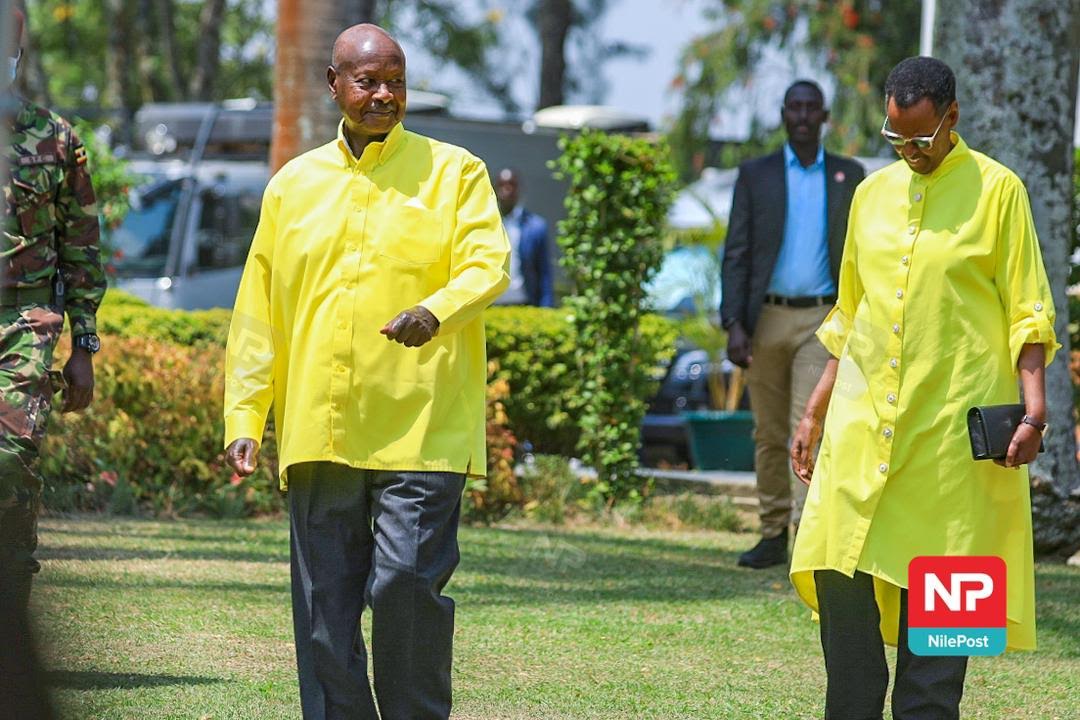
President Museveni on Sunday, January 18, 2026, officially received the declaration confirming his re-election as President of Uganda, a milestone that extends his leadership to a record fifth decade in power.
Museveni, who won more than 7,946,772 votes according to provisional Electoral Commission figures, was presented with the official declaration form by the National Resistance Movement (NRM) Central Executive Committee (CEC) at his country home in Rwakitura.
In his acceptance remarks, President Museveni began by acknowledging divine guidance and the support of his wife, First Lady Janet Museveni.
“I want to thank God for this victory and for all the victories we have had over the last 55 years of struggle since 1971. I also thank Maama Janet for her support,” he said, framing his victory as a continuation of a long historical journey in Uganda’s politics.
Museveni credited the win to collective effort, praising members of his party, state institutions, and community leaders.
“I want to thank the NRM members and all the leaders because they all played a critical role in this victory,” he said, adding, “I thank the armed forces for their role, the religious leaders for praying for us, and the cultural leaders for being responsive and working for peace.”
Reflecting on voter participation, Museveni noted that approximately 10 million registered voters did not turn out to vote. He suggested that many of those non-voters were NRM supporters, emphasizing the need for the party to study the reasons for low turnout.
“About 10 million of our people did not turn up. Many of them are our members, and we must find out why,” he said.
Museveni’s 2026 victory continues a political trajectory that began with his rise to power in 1986 following a five-year armed struggle.
Since then, he has consistently won national elections under various political arrangements, including single-party rule and multiparty democracy. This election marked another contest against Robert Kyagulanyi, popularly known as Bobi Wine, a challenger who previously ran against Museveni in 2021.
NRM officials described the outcome as Museveni’s most decisive win, with the party’s overall vote share rising from 58 percent to 72 percent, reflecting a strengthened political base.
Speaking on national development, Museveni emphasized the importance of restoring unity and stability in regions affected by past conflict.
“That atmosphere of maximum unity is coming back,” he said, referring to northern and eastern Uganda. He highlighted government initiatives such as the Parish Development Model (PDM) and presidential skilling hubs, which he said have started to restore hope among Ugandans.
________________________________
Historical Context: Museveni’s Electoral Trajectory
Museveni’s victory in 2026 follows a long political trajectory. Having first assumed power in 1986 after leading a guerrilla movement that ended years of civil conflict, Museveni has been a defining figure in Ugandan politics for nearly four decades. In successive elections under both no‑party and multiparty systems, he has maintained his hold on the presidency.
In terms of vote counts, the provisional 2026 total of nearly 8 million exceeds the raw vote totals he secured in previous polls:
- 2021: 6,042,898 votes
- 2016: 5,971,872 votes
- 2011: 5,428,369 votes
- 2001: 5,123,360 votes
- 1996: 4,428,119 votes
While earlier elections such as 1996 yielded a higher vote percentage — Museveni won 74.33 % of the vote that year — the raw number of votes in 2026 surpasses his previous totals, reflecting population growth and higher turnout.
The primary challenger in the 2026 contest was Robert Kyagulanyi, widely known as Bobi Wine, leader of the National Unity Platform (NUP). Museveni defeated Kyagulanyi by a wide margin, with the final official tally far exceeding the opposition’s showing.
______________________________________
“PDM has given people hope that we can get rid of poverty,” he said, adding that the skilling hubs are equipping young people with practical abilities.
First Lady Janet Museveni also addressed the CEC gathering, thanking party members and leaders for their support during the campaign.
“I want to congratulate the extended family of the NRM. I am deeply grateful to God for allowing this to be the first programme of this Kisanja, where we meet with the Central Executive Committee and the Secretariat to first thank Him,” she said, praising the collective effort that led to the victory.
Vice President Jessica Alupo called on Ugandans to remain united following the election, describing the outcome as “a moment for thanksgiving and national reflection.”
She congratulated Museveni on what she termed an “overwhelming victory” and commended the Electoral Commission for delivering results peacefully.
The Speaker of Parliament, Anita Annet Among, praised the ruling party’s parliamentary performance, noting that the NRM had secured 352 seats in the recent legislative elections.
“Yesterday's declaration is a testament to the trust that the people of Uganda have in NRM and in you, Your Excellency,” she said, commending the President for his inclusive campaign and openness to ideas from party leaders.
NRM Secretary General Richard Todwong highlighted the movement’s strong grassroots performance, saying, “We campaigned and reached out to every NRM member we could. We saw that our base was awakened, and people responded.”
He also acknowledged the First Lady’s contribution, saying, “The support you give us encourages and strengthens the party.”
As President Museveni embarks on another term, he emphasized unity, discipline, and development as the pillars for the future.
“If we do these things, we shall unite our people and build a stronger country,” he said, signaling continuity in both governance and policy priorities.
National Unity and Security
Museveni warned against isolated acts of political violence he described as linked to “political extremism,” stressing that peace in Uganda is maintained not only by security forces but by all citizens.
“It is not just the security forces who are maintaining peace,” he said. “It is all Ugandans, including members of the opposition.”
He issued a direct warning to groups he accused of working with foreign interests: “This is a free warning from me. Stop what you are doing. We shall maintain peace in Uganda.”
First Lady Maama Janet Museveni, also Minister of Education and Sports, echoed her husband’s rhetoric of faith and unity, congratulating the NRM for its electoral victory and urging leaders to renew their commitment to serving Ugandans.
“I want to congratulate the extended family of the NRM,” she said. “I am deeply grateful to God for allowing this to be the first programme of this Kisanja... because only God made this possible.”
Vice President Jessica Alupo praised Museveni’s leadership and resilience during the campaign, saying his approach brought together people from all walks of life across the country.
“This is not the day to give a detailed account of the campaign, but Your Excellency demonstrated a very fatherly approach,” she said.
Speaker of Parliament Anita Annet Among noted the confidence Ugandans have in both the NRM and Museveni, saying the party moved from 58 % to 72 % vote share through an inclusive campaign strategy.
“The results are a testament to the trust that the people of Uganda have in NRM and in you, Your Excellency,” she said.
With Uganda’s oil production expected to begin this year, Museveni said the revenues will be invested in infrastructure, education and regional integration rather than direct cash transfers.
“Our oil will start flowing this year,” he said. “This money must be used for things that will last, like railways, power stations, roads, and science education.”
As the NRM leadership and government now transition into a new Kisanja, or era, President Museveni signaled his intention to focus on unity, disciplined governance and sustainable development.
“If we do these things, we shall unite our people and build a stronger country,” he said.
